
May 13th, 2023: Today was different. What do the three ‘P’s mean? Just wait until you read the entire part!
Today was the last day in the apartment. And it was on this day that we had to move to St. Petersburg. The train was scheduled to depart at 15:00. The alarm rang at 07:30, but I snoozed until 9:00. And when it was time to get up, I was quite drowsy. Indeed, the trip was exhausting, and I required recuperation. Mum awoke at 08:00, by the way. We went shopping in the neighborhood for breakfast and lunch, as we planned to dine here before heading to the train station.
We went to a few stores other than EUROSPAR to get the necessary supplies. Every cashier at the supermarkets we visited looked at us with curiosity. There were no complications as long as we had the cash. Our journey was different. We went to Prospect Mira through a side entrance from a school. The path was closed off for the Moscow Bikers Marathon. With police cars stationed for security, the riders deviated from the path. A lady in front of us waved to the bikers, who waved back. I tried the same thing, but I didn’t get anything back. There was only one rider who nodded to us. I would not wave like this in my home country. Then we entered another alley, and as the motorcycles passed by, I waved again. They did not reciprocate.


Mum, on the other hand, made fun of me and ridiculed me to this day as the “joke of the day”. I didn’t take it as a joke; it was simply a lack of courtesy. I decided to get a Russian debit card. For the past few days, I’ve been looking for a Russian bank that could provide the card at no cost. I declined Sberbank’s because we had to pay 2000 rubles for it. The same goes for the VTB Bank. According to what I’ve read, Raiffesenbank and Tinkoff Bank will be the banks where you can obtain something for free. However, I’ve heard that the former is pulling up its operations due to the war. Tinkoff was a possible alternative. I downloaded the mobile app from the Google Play Store. And got the wheels in motion. I was conversing with a Tinkoff employee (presumably a’star’ employee, since I’ve seen her face in a handful of Russian Tinkoff Bank advertising, both on TV and in the mobile app). Maria was one of the few staff that spoke English. But I messaged her in Russian to demonstrate my respect as a guest. After some discussion, she agreed to issue one if I submitted my passport, visa, and migration card to the Tinkoff database. After that, I decided to pick up the card in St. Petersburg on Wednesday (17th May, 2023 — you might say it’s too late for a trip.) at 21:00 hours.
Anyway, we returned to our flat and began preparing for breakfast and lunch, which was definitely Russian cuisine. The doorbell rang at 12:00 p.m., as I was enjoying my lunch. A woman informed us that we were about to be evicted and instructed us to vacate the room within the next five minutes. Oh no! We hadn’t packed our baggage or dressed up. I could not really argue or bargain with them. I informed the woman that Daria had agreed for us to leave at 13:00 hours. She nodded in rejection and departed.
I checked my phone, and Daria texted me that we needed to depart by 12:00 p.m. or earlier, as that was the check-out time. She initially sent a set of messages to my WhatsApp chat, and I overlooked the check-out time. That woman was sitting there as I went out to empty the major rubbish bins in the unit. “Are you exiting?” she inquired. The receptionist stared at me curiously. I returned to the flat, and Mum was furious. Was there a misunderstanding when I sent the message to Daria yesterday? We hurriedly changed our clothing and packed our baggage before leaving the room. The key was returned to the box, which was code-protected.
You should’ve seen how Mum was. As we boarded the elevator with the four suitcases, my mind raced. As we approached the ground floor, we went without saying farewell. I sent another mail to Daria, criticizing the aforementioned. I had no idea such laws were so strictly enforced in Russia.
We hauled our baggage to the T-shaped crossroads, which housed the MAGNIT store. And reserved a taxi from YandexGo to take us to Leningradskiy Vokzal, from which the Sapsan train departs at 15:00. It arrived, and the taxi driver, Mr. Vladimir, advised us to hire another cab because the bags wouldn’t fit. I originally agreed with his proposal, but Mum advised him to make as many adjustments as possible. And he did. Mum questioned me, “Am I out of my mind?” While we were in the taxi, she chatted to me in her native language. She was just crazy! I was often pressured to block Daria on WhatsApp, but I refused since I did not want to jeopardize our business relationship. I still thought she was lovely and helpful. But she still didn’t respond to my message.
I maintained my cool. The taxi transported us to our destination. And it was 13:30. We dragged them to the entrance. (The station doors were quite thick and robust, so pushing or pulling them was difficult. Once slipped, they return quickly), loaded them into the security check-in conveyor, and proceeded to the waiting room. Many railway stations in Russia have the same layout and appearance. Immediately after the door was a hall with ticket counters and a large electronic board displaying the departures and arrivals of each train. Stepping down from the hall, there was another spacious one with greater ventilation and lighting. There were advertisement banners above, bookstores and eateries below, with ample seating, all neatly arranged. Some advertisements pushed Russian youth to join the army and be deployed to the battlefields of Ukraine. An elevator to the first level leads to a tiny cafe. That is what the Leningradskiy Vokzal looked like.


Mum and I were reading the news on our mobile phones. The struggle for Bakhmut in Ukraine was raging at the moment, and that was the top story in Russia. Our country held municipal elections on May 10th, and we were watching the results (because that day was the “counting day”). Mum asked me to speak with a railway official about the specifics of our train, such as which platform it will arrive at and what seat number we would be assigned. I mentioned that most of it would be presented on electronic boards. I resumed my lunch.
Meanwhile, Daria reacted. She apologized for what happened, but reminded me that the messages on the check-out screen had to be followed, which I should have read back then. I apologized to my mother for my mistake. Something I’ll remember for the future.
The watch read 14:45, and information regarding our train appeared on the board. Our seats were 3 and 4, wagon number 5, and platform number C. And we went straight to the long-distance trains area. There were advertisements in the waiting area, and at the time we visited, they were for the Marinsky Theatre in St. Petersburg. I went to the platform, where we waited for the train to arrive. I left to use the restroom, which was located in the basement. And I returned to the platform to witness a large crowd waiting to travel to St. Petersburg. An old woman with her suitcase was standing. I called out to her and asked her to sit. And she went in the opposite direction. I completed my lunch and threw it in a wastebasket attached to our waiting seats. Not so soon after I noticed a Russian woman come up to the dumpster and spat.
And about 15:00, the Sapsan arrived at the platform. The train was designed by Siemens and resembled the ICE trains of Deutsche Bahn (DB) in Germany, although it was specifically constructed for the Russian gauge. The wagon doors opened, and the crew stepped out in their red uniforms to help people enter after checking their tickets. We needed to present our tickets and passports. A stranger entered the train, which astonished the ticket conductor.


We entered the Sapsan. It looked heavenly. This is our first trip on a high-speed train, which we don’t have in our own country. We purchased a ticket to St. Petersburg in bistro class. A Russian woman and man sat opposite our table. In shaky English, the young man inquired as to where we were from. He was a student at a technological institute in Saint Petersburg. The middle-aged woman did not interact with us. Despite the fact that they were unrelated, they soon bonded because they shared the same race and spoke the same language. Announcements were made in both Russian and English. The train will stop at two stations: Zelenogorsk and Chudovo. The route will follow the Volga River, via Tver, and into St. Petersburg, ending at the Moskovskiy Vokzal.
After passing through Zelenogorsk, our surroundings immediately changed from cityscape to forests and lakes. We honestly did not verify the Sapsan train’s class when we booked it. Two crew members, Yevgeny and Natalia, were assigned to Wagon 5. The latter was assigned to our row. The Sapsan menu had a QR code, which had to be scanned to access it. Everything was in Russian. I was having trouble reading the menu because the network outside of Moscow was inconsistent. And as we approached another town, the network came unexpectedly, and the Translate application performed brilliantly, providing me with the much-needed English results. Mum and I made our selection of stuff. Natalia didn’t understand English, so I had to read each of our stuff aloud in Russian. The passengers in the adjacent row chuckled as they looked at me. The woman and man sitting across from us were looking at us, wondering how I was able to read these. The crew hostess complimented them on their immaculate reading and encouraged them to learn Russian the next time they visited.


You needed to push the button above us. This was to contact the crew to have your products delivered to you. Take a peek at the menu. (It is completely in Russian). Now let’s talk about the bistro class. As we entered for the first time, there was a communal bathroom adjacent to both wagons, followed by an in-house mini bar where, in addition to confectionery, we could purchase toys, bags, and miscellaneous stuff. All of them were mentioned in Sapsan Magazine. The bistro class has 32 seats and adequate luggage storage. There was also a class for guests with pets. So, when you book this train, please take the time to go over their brochure. If I recall correctly, they have first class, business class, economy class, and bistro class. I didn’t research the Sapsan train, therefore the return ticket we booked was a disaster. Look over the photos below to get a general concept of how the landscape appears.
The toilets appeared to be in excellent condition. A vast cry from how they appear in our home country. It was 19:00 hours and still daylight. We arrived St. Petersburg.
For me, St. Petersburg is the city that I can never escape because it has this special energy, even a dark energy. It keeps pulling me back.
– Anna Netrovka.


The collage of pictures depict the Moskovskiy Vokzal, as viewed from the train and outside the train.
The Sapsan train terminated at Moskovskiy Vokzal. The railway station was comparable in form and layout to the Leningradskiy Vokzal. Many people were waiting to travel to Moscow, hence the name. When we exited the building at 20:00, the sky was a brilliant light-blue. Obviously, St. Petersburg is positioned north-west of Moscow. And it was cooler than Moscow. The lowest temperature of the day was -10 degrees Celsius. This is Russia’s second-largest city by population. Its geographical location is significant, as it is around 120 kilometers from the Finnish and Estonian borders. As a result, rail and road connections to Helsinki and Tallinn are existent and well-developed.
We had planned a vacation in St. Petersburg from the 13th to the 19th of May, but it was postponed by one day due to our hectic travel schedule, which prevented us from visiting some locations of Moscow. We booked a room in the ‘Statskij Sovetnik’ apartment, located at 7-ya Krasnoarmyskaya Ulitsa, using the Ostrovok.ru website. I emailed the personnel. Yevgeny and Olga (from the Statskiy Sovetnik) were polite and prompt in their responses. They said we should grab our keys at 2B Kustarny Lane and then go to our flat.
I booked a taxi with two stops. The driver was Tajik. He was polite to us, despite the fact that we couldn’t communicate much. We reached our first stop. That was the office of Statskij Sovetnik Apartments. After ringing the calling bell, we went inside. The interiors are really dark. Yevgeny sat there and welcomed us. When I told him about the planned date, he told me to pay for the days we’d be staying appropriately. Even though he is Russian, he attempted to communicate in broken English. He completed the visa registration process and handed us the keys. Thank you. “Enjoy your stay,” he said. Next to our flat. We arrived at our apartments. It did not look as neat as Daria’s place. I was somewhat aback when I saw that our accommodations were on a tight dinghy. A roadway bordered with old structures. That was the 7-year-old Krasnoarmyskaya Ulitsa. We had to enter via the gates to reach the modern-looking flats, which alleviated my concerns. And we entered Room 4. It looked decent.
Okay, so far, so good. We needed to get groceries and prepare for dinner. I had a substantial lunch both in Moscow and on the train. We proceeded to a local supermarket, DIXI, and purchased our groceries. While returning, I was disgusted to discover overflowing rubbish containers. This was starting to look like our country. There are not many individuals in this area. At 22:00 p.m., the sun began to set. Fortunately, our rooms had thick curtains that blocked out light, ensuring that our sleep-wake cycle was not disrupted.


Unlike Moscow, I didn’t plan what to do and see in St. Petersburg. I hastily made a plan in this manner:
- May 14th: Vyborg and Peter & Paul fortress.
- May 15th: Shisselburg and Hermitage
- May 16th: Pushkin
- May 17th: Peterhof
- May 18th: That was day when we will return back to Moscow. To see the rest of the monuments and sightseeing places like St. Isaac’s Cathedral and Kazan Cathedral.
This plan lacked sense. And this came to haunt me forever…
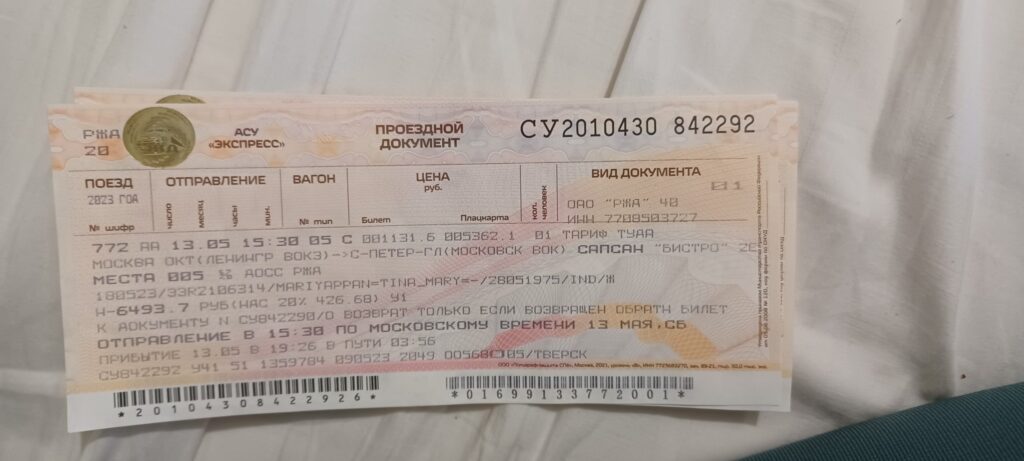
The ticket for Sapsan’s Moscow to St. Petersburg.
May 14th, 2023:
The day I will never forget in my life. My poor planning and a lackadaisical approach almost cost me my trip.
Vineet Mariyappan
The aforementioned quote is correct. I will stand by it 100%. As I previously stated, I was okay with bag-packing on the fly and moving on. But I realized, through a lesson, that I would not forget. My plans had to shift considerably after that. No more writing on the back of shopping bills!


The first four pictures show the streets in St. Petersburg before going to the metro. Pictures situated in the middle show the Ploschad Lenin metro station. The picture on the lower right shows the inside of the train to Vyborg.
I awoke at 08:00 hours. The weather appeared clear. We planned to visit Vyborg after purchasing breakfast supplies from the same store (which was only 800 metres away from our flat). Why did I think of going here? Four reasons. First, I’d heard of the Karelian region (which is located in both Finland and Russia) and was familiar with its history. I was fascinated about the Karelian culture. This region was previously part of Finland, but the vegetation and fauna differed slightly. It played a significant role in World War II’s Winter War and Continuation War, as well as the siege of Leningrad. Second, the town was mentioned in my Lonely Planet guidebook. It was possible to get to this place in one day. Third, it was part of St. Petersburg’s Silver Ring (much as Sergiev Posad was part of Moscow’s Golden Ring). Fourth, I play a computer game called “Euro Truck Simulator 2,” and this town is featured in the game. The village served as a doorway to St. Petersburg, where I (virtually) loaded up the truck. Vyborg looked wonderful in the game, and I wanted to see it for real. I assume those reasons weren’t good enough.

Here’s some information on the St. Petersburg metro station. This is easier than Moscow’s. The picture above shows the sign for St. Petersburg’s Metro. The nearest metro station to this apartment was the Technology Institute. We received a “Porodizhnik” card, which is the equivalent of a Troika in St. Petersburg. Unlike the Moscow Metro kiosks, which exclusively supplied information in Russian, this one offered information in Russian, English, Chinese, and German. In addition, unlike in Moscow, the signage within the metros is also translated into English.
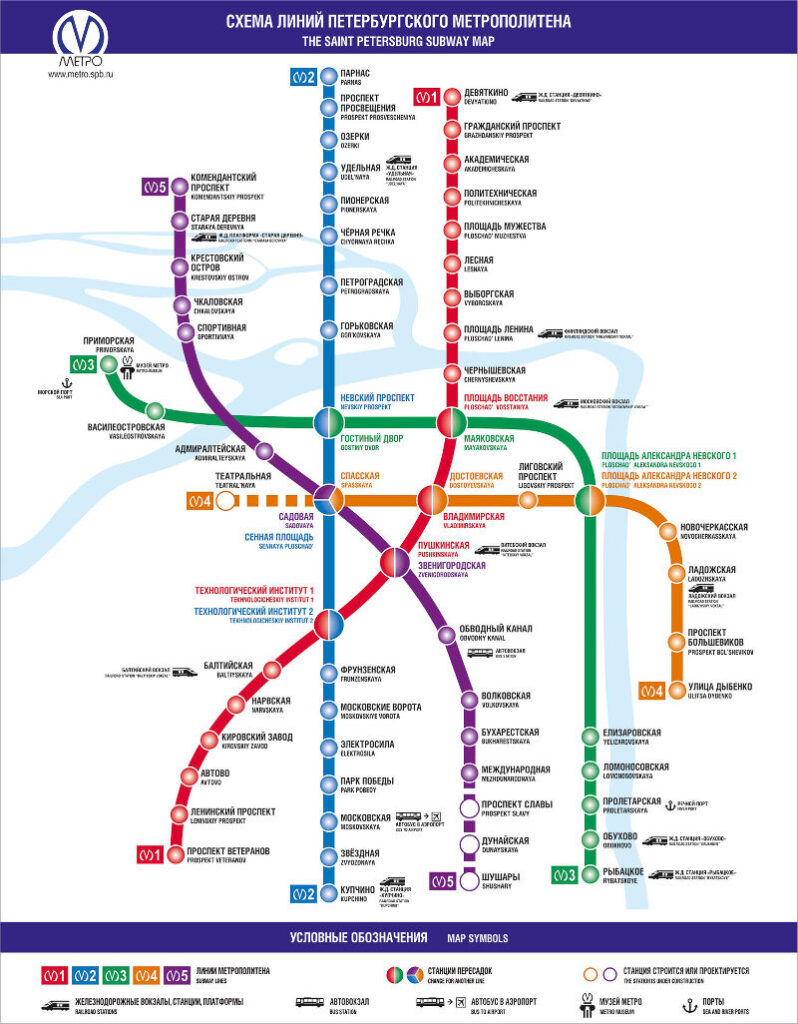
We needed to go to Ploschad Lenina, where we could enter the Finlyandskiy Vokzal (literally, the railway station to Finland). To travel to communities like as Udelnaya, Kannel’yarvi, Vyborg, and Zelenograd, catch a suburban rail from this station. Similarly, a high-speed express train called “Allegro” ran between St. Petersburg and Helsinki, but it has been canceled due to current conditions. We purchased the suburban tickets to Vyborg. When the clerk handed us the tickets, she seemed taken aback by our appearance. The suburban train to Vyborg was fairly full. As the train approached its destination, numerous passengers disembarked at Zelenograd. Finally, only a few people, including ourselves, made it to Vyborg. I noticed the Western High Speed Diameter Highway, which I remembered from the truck simulator. Forests have given way to subarctic tundra vegetation. Further ahead, some railway stations were called after the distance traveled from St. Petersburg, such as the “117 km” station. The area was studded with trees and Karelian-style dwellings. We arrived at Vyborg around 11:30 a.m.
The town, also known as Viipuri in Finnish, is located in the Leningradskiy Oblast. It had a colorful history as part of Finland until being taken over by the USSR during the Continuation War. The main attractions here are the Vyborg Castle-State Museum and Monrepos Park. The railway station lies midway between St. Petersburg and Helsinki. It was easy for the Russians to enter here. How about non-Russians, like us?


The platform was narrow, and we entered the exit gate. It led to an underground subway that linked to the train station’s main hall. As I was walking towards the castle following the directions on Yandex Maps, I ran across a Russian police officer. My terrible… She told us to come along. I assumed they wanted to check our paperwork and let us continue our journey. She knew English and inquired as to why we had traveled to Vyborg. She said, “Very good” after I answered the question. She directed the other police officers to contact the border officials. Civilians were coming and leaving from the hall, purchasing tickets to travel to their destinations, and it was business as usual for them. In the thick of it all, I wondered, “Did I land myself in some trouble?” The other police officials were thoroughly inspecting our passports and visas and asked me again where we were heading. I answered it again, and one of them accused me of lying. Two officials in plain clothes approached us at the entry and confiscated our passports, telling us to follow them. That female police officer said, “Good luck!” My heart started beating quicker. We were escorted downstairs and into a detention room.
My thoughts became really dizzy, and Mum was terrified. The room was completely painted yellow. There was one bed and two chairs. There were images of numerous refugees and smugglers on the wall to my right as I sat. I realized at that point that Vyborg was located on the Russian border, and this was one of the ways for refugees to illegally enter Finland (EU territory). A global map was stuck there, along with the name Babu Ali, which was printed in English on it. Another sign was posted there, including a picture of a Russian military apprehending an immigrant and reading “DO NOT CROSS THE BORDER! “You have been warned!” in English. Handcuffs were fastened on a nail near the pictures.
The two border officials sat at the table in front of us. And they just knew Russian. They asked some questions in Russian, which we clearly couldn’t comprehend. Interrogation began. I tried to be calm in a situation where we were in difficulties and unfamiliar with the language. One of them, a bald-headed man (who resembled Jason Statham in English films), turned to English and inquired what we were doing here. I responded. He did not believe it. He claimed I was lying and may be arrested. That person began taking notes about what we were doing in Russia. He inquired about our entire journey, beginning in Bengaluru and continuing all the way to Vyborg. The facts, including the hotels we stayed at and where we went in Moscow, were pulled from us. The other person, a bearded man, snatched our cell phones. My god! This was serious crap! He asked me around five times whether I wanted to cross the border and run away to Finland. And I said, “Olaf, Olaf…”, referring to the castle’s St. Olaf’s Tower.
He noticed our documents and grew suspicious because we were Indian. I had to explain that we came to Vyborg for a legitimate reason, not as a refugee crossing the border. We displayed the tickets back to Bengaluru and explained that we had booked and paid a lot for the Sapsan train back to Moscow (7,000 rubles). I also informed him that I was a doctor and that I needed to return to my own country to fulfill my social obligations. I also had to show him my employment joining letter. Mum was in tears and spoke bitterly. I felt so terrible for whatever I had gotten us into.
The bald guy then searched our phones and inquired who “Appa” was. (It means “father” in Indian). Then he inquired why Dad didn’t accompany us to Russia. We were potential refugees because we were a mother and boy traveling together! He went through my complete contact list and previous calls. He inquired about the calls beginning with “080”, to which I explained that they were local calls made from Bengaluru while we were in India. He asked me once more if I was lying. My WhatsApp conversations were thoroughly reviewed. Fortunately, nothing came out. He did not check my Twitter or Instagram, which I had temporarily blocked before traveling to Russia. He didn’t check the Microsoft Outlook application because he wasn’t aware of it. (They utilize mail.ru, which I fortunately didn’t have). The second man was searching Mum’s phone. She was outraged that her privacy had been violated. Every call she placed to her relatives in India and overseas was monitored.
I pleaded with him to let me see the town. He asked, “If you came to St. Petersburg for tourism, why is Vyborg your first stop? “You haven’t even visited the tourist attractions in St. Petersburg.” The bearded guy showed us a photograph I took at Park Pobedy. They inquired if I truly fled to the Russian border. The picture depicted the Russian Federation’s border markings in Victory Park. I mentioned that I am an ardent photographer as well, and I may have taken many similar images. Obviously, they were not convinced by that response. Since I was standing there, I noticed the man scrolling through all of the images in the Google images mobile app. It took him around 20 minutes to see the photos I took during the current trip. He did a Google search for Russia and found a news item stating that their men were besieged in the battle for Bakhmut, which he showed me. I knew his intention was to see if we were Ukrainian saboteurs. They called a few of their senior officers. Later, they told us the following.
- “Do you know Vyborg is located 20 km from the Finnish border?”
- “If you cross outside the city limits, you can be heavily penalised.”
- “Before you leave the station, ensure you book the tickets back to St. Petersburg and show it to us that you will be leaving in the afternoon. You have two hours time here.”
The cops said, “Excuse me” and directed us to return to the station, buy the tickets, show them, and go. When I looked back at the folks, I thought, “Really? Why the Hell did we come to Vyborg? To have ourselves harassed?”. But I allowed civilized thoughts govern my head when I purchased the tickets for the departure at 15:00 hours and showed them to them. The interrogation lasted 1 hour and 30 minutes.
When we exited, my Outlook application sent a notification. It was an e-mail from the Luxembourg Ministry of Consular Affairs addressing the denial of my appeal (remember that going to Europe was our original goal). I appealed to them and took time away from work in my hospital to plan a European trip. I had to make a written appeal to them via e-mail. Unfortunately, they stated that our final destination was Germany, and we had some time to appeal in their courts. If they looked at that, they would very probably deport us. That letter was a “bomb” during this tense time. I deleted the email.
We walked to the bus stop, and as a result of Mum’s scoldings, I accepted responsibility for my actions. She berates me for the mistakes I make on a daily basis by comparing them to what has transpired here up to the present. This almost cost us the trip. I pressed the panic button and alerted Dad immediately. He was on his way to see his relatives and instructed us to stay within the municipal limits. Seriously? I was a tourist and an explorer. It is not illegal to visit a well-known sightseeing tourism spot. In that situation, how will non-Russians get to Sortavala and board the legendary Ruskeala Express to Petrozavodsk? That is noted in RZD Railways’ travel magazine, which is in English. If this is their strategy of detaining and interrogating non-Russians, why will their historically famous express be advertised? It is all hypocrisy. One culd also be interviewed at Sortavala, which is 10 kilometers from the Finnish border. I resolved that I would take the rest of our trip seriously. All future planning should take place in the city. Shisselburg was instantly removed from my plans. That ended my dream of visiting Ladoga Lake. However Shisselburg was located east of St. Petersburg and is not near any international borders.


When I returned to Vyborg, I only had time to visit the castle. Monrepos Park was not part of the tour. We rode a marshrutka to Petrovskaya Ploschad, then turned left and began walking towards it (1.2 kilometers). The Saimaa Canal joins the Gulf of Finland via Vyborg Bay. If you look at a global map, you can see that Vyborg is located on the Karelian isthmus. The castle was practically on an island, encircled by Vyborg Bay. The complex is free to enter, however accessing the museum costs 1,000 rubles. The St. Olaf’s Tower is now closed due to ongoing renovations.


The castle has its unique history. The Swedes built this fortress as a military stronghold to defend their area from the Russians of the Novgorod Republic. Its location was significant because it was near to the bay and navigable river passes were being monitored. It was one of Finland’s three great castles until being taken over by the Soviet Union. The castle was left to crumble until 1994, when a crew of archaeological restorers from St. Petersburg worked to preserve it. As we traveled down the slope toward the museum, we noticed a makeshift camp. The workers exhibited their brick-making skills to the public. Mum immediately stated she’d stay behind and ordered me to arrive at 14:00 precisely. Right now, it was 12:30 p.m. I rushed up the stone-laced incline, admiring the picturesque view of Vyborg town. The route abruptly widens before turning into a gate. I passed by and spotted the museum’s entrance. The entrance to St. Olaf’s Tower was located opposite the museum and was currently closed. I entered the museum. It featured Vyborg’s history from the Stone Ages, prehistoric artifacts discovered on the Karelian isthmus, and jewelry. The first hall presents a timeline of Vyborg’s history in visual graphs, with priceless items listed underneath. The castle’s building was shown in the following halls. Behind the paintings, you could see the bricks that made up the medieval castle wall. As you go, you will notice the development of this town into a prosperous port surrounded by its own fort. A 3D reconstruction of it is shown here. There were several paintings of the castle and town.
I photographed the Russian and Finnish border-marking structures in the museum. Vyborg was significant in Finnish history. Finland had to give up 12% of its entire land area to the Soviet Union. Its significance as Finland’s first pharmacy (established by Petter Gottfried) and the unique library cannot be overlooked. As you pass by, there is a hall with old images of this town (Viipuri in Finnish). Some represent local athletes, the development of a chicory factory, Finland’s oldest theater building, certain plays performed at the Viipuri Stage, prizes won during the games, and Finnish lyrical literature written by Jean Sibelius and Ernst Linko. In one corner, there was a memorial to Otto-Iivari Meurman, a Finnish architect who played an important role in Vyborg’s city planning. Old newspapers, Finnish house signs, cash, cigarettes, beverages, candles, cosmetics, guns (including one of the oldest Bibles), books, and street names are displayed. A portion about the Finnish trading corporation Hackman & Co is also shown.
Interestingly, the explanations are provided in Russian, Finnish, Swedish, and English. A hall with a typical Viipuri-style dwelling and native vestments was also displayed. Mosaics were displayed, I believe. It’s crucial to understand what to expect when visiting this museum. At the time, the bulk of the population was Finnish, with Russians being a minority.


This altered during the Continuation War. Another hall depicted the fighting and the Soviet victory. The Soviet Union’s triumph flag was draped there. There were many visitors in this section (mostly Russians). miniatures of Soviet and Finnish aircraft, Red Army soldier battle armor, Russian propaganda, ballistics, firearms, swords, USSR-awarded medallions, and tank miniatures were on display. Along with infographics demonstrating the Red Army’s advance and how it built the current Russian-Finnish border. This was important because they wanted a buffer zone around St. Petersburg. There are two other halls that portray the nature and fauna of Vyborg. The soil in this location was artistically depicted as an infographic, together with numerous fungus, grass, trees, and fauna. Of course, artists created the fauna to look lifelike, but the rest of it was real. The map depicting the various soils in St. Petersburg, Vyborg, Kamennogorsk, and Zelenogorsk was visually appealing. Overall, the castle and museum were amazing, and I highly recommend that you visit this precious treasure.


The last picture shows the Lastochka train from Vyborg to St. Petersburg (Finlyandskiy Vokzal)
It was exactly 14:30 hours when I emerged and rejoined Mum. We walked through the city to the railway station. I wanted to visit the antique buildings and streets shown in those images. The landscaping around the castle was stunning, as it always is. We wanted to visit the market. It was an open square. They were selling items similar to those sold at flea markets. I considered buying anything from here, but none of them are created locally. We had a short falafel lunch before heading to the railway station. Mum informed me, as we walked down the street, that a Russian police officer was following me wherever I went. I did not bother. At the same time, I realized that they were simply performing their jobs and had no ill will toward us, no matter how bad things became. You can glance at the photographs presented below to see how Vyborg looks. The main street is Lenin Street. Even though it is a small town, you can notice the city’s structured layout, which includes limited footpaths and a distinct bike track. And we returned to the train station. We purchased tickets back to St. Petersburg. The train was a Lastochka model. Of fact, it appeared far more modern than the passenger train.
The tickets had no allotted seat numbers, so you could sit wherever you wanted. We arrived in St. Petersburg about 17:30 hours. I wasn’t happy with this excursion, but I was pleased with the museum. Also, I didn’t want to continue with the journey today. To alleviate my melancholy, I listened to music. The train stopped at Finlyandskiy Vokzal. As we proceeded towards the railway station’s exit gate, I considered returning here for a future trip to Helsinki after the war. Probably Monrepos Park too?


Our brief ‘lunch’ did not meet our requirement for calories or protein. We went to a nearby EUROSPAR and finished. The main sightseeing attractions in St. Petersburg close at 17:30 hours, so Mum recommended we take a cruise along the canals of St. Petersburg. Remember, Tsar Peter I (the Great) wanted Russia to be westernized, therefore he decided that his city (St. Petersburg) should have a European appearance and feel. The Tsar’s visit to Venice, Italy inspired the city’s architecture. As a result, there are several waterways across the area. The Neva is St. Petersburg’s principal river, with tributaries named Bolshaya Neva and Malaya Neva (meaning great and small Neva, respectively). The waterways were formed in such a way that St. Petersburg also had islands, particularly Vasileysky Island.
St. Petersburg is positioned at the eastern end of the Gulf of Finland, and before the war, there were ferries to Helsinki and Tallinn. Despite the conflict, there are several ferries and hydrofoils that travel around the rivers and canals. I consented to a cruise so that we could become oriented to the many destinations we needed to see in the coming days. The voyage cost 1000 rubles each guest. Just before the commencement, a man approached and photographed both of us. We traveled through the main canals and the Malaya Neva river. A man seated inside the boat was using a microphone to tell about all of the places we passed by on the excursion in Russian. I couldn’t understand, so I utilized Yandex Maps to geolocate locations. With each passing minute, the temperature dropped further. As we returned from the cruise and took a taxi to our apartment, I had an unsettling feeling. “Would Statskij Sovetnik be informed of our journey to Vyborg? Will the police be there to arrest us for entering a border zone without a permit?” When we arrived home, nothing occurred.
Leave a Reply